

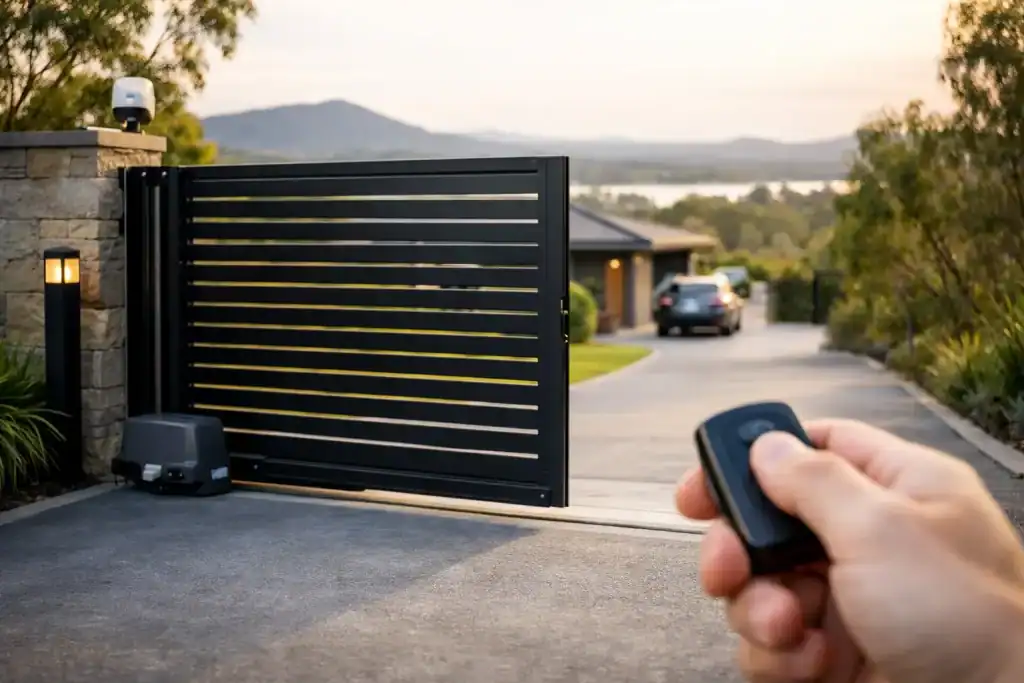
A front boundary is often the first point of opportunity for an unwanted visitor. It is also the first impression of your home or business. Well-designed automatic gates can control vehicle access, create a clearer private boundary and add a finished look to the street frontage without making the property feel closed in.
What an automatic gate should achieve
An automatic gate gives you control over who drives onto your property and when. Rather than leaving a driveway open while you are at work, away for the weekend or busy inside, you can operate the gate by remote control, keypad, intercom or approved mobile access system. This is particularly useful for families, businesses with deliveries and properties where vehicles, tools or equipment are kept out of sight behind the front boundary.
Security is only part of the decision. A solid, properly positioned gate can improve privacy from passing traffic and pedestrians, contain pets and children within the property, and make the entry feel more intentional. Slat infill, for example, can provide a contemporary appearance while limiting direct views into a driveway or courtyard. More open designs may suit properties where visibility and a lighter frontage are the priority.
For many owners, the best result comes from matching the gate to existing fencing, security doors, privacy screens or shutters. This creates a considered exterior rather than a collection of separate security upgrades.
Choosing between sliding and swinging gates
The driveway itself will often determine the best gate style. There is no single design that suits every Canberra property.
Sliding gates for tighter driveways
A sliding gate travels along the fence line, making it a practical choice where a driveway rises towards the house, opens directly onto a street, or does not have enough clear space for gate leaves to swing inward. They are commonly used on residential side access, wide frontages and commercial entrances.
A sliding gate needs sufficient run-back space beside the opening. The fence line must allow room for the full gate panel when open, and the ground or track arrangement needs to suit the site. On sloping or uneven blocks, the supporting structure and gate travel need careful planning before manufacturing begins.
Swinging gates for a traditional entry
Swing gates open inward or, where site conditions allow, outward. They can offer a more classic look and work well on level driveways with available clearance inside the boundary. A single leaf may suit a narrower opening, while double leaves can create an impressive entrance for a wider driveway.
The trade-off is clearance. Vehicles must stop far enough back for the gate to open safely, and the swing path must stay clear of parked cars, landscaping and foot traffic. A gate should never create a hazard for people using the footpath or entering the property on foot.
Automatic gates Canberra sites need to handle local conditions
Canberra’s cold winters, summer heat, wind and occasional heavy rain place real demands on outdoor fixtures. Powder-coated aluminium is a popular option because it is low-maintenance, available in a broad range of colours (also available in wood grain) and suitable for modern slat gate designs. Steel can be appropriate where a heavier or more traditional style is wanted, provided the finish and ongoing maintenance are suitable for the environment.
Wind exposure should be considered on rural properties around the ACT and is often overlooked. A fully solid panel offers excellent privacy, but it also presents a larger surface to gusts. Spaced slats or a more open pattern may reduce wind loading while still giving useful screening.
Access control should suit everyday life
The most secure system is of little value if it is frustrating to use. Before selecting controls, think about everyone who needs access: household members, staff, tenants, cleaners, trades, deliveries and emergency services.
Remote controls are simple and familiar for regular drivers. A keypad can reduce the need to distribute remotes, although codes should be changed when staff leave or circumstances change. Intercoms allow you to verify visitors before releasing the gate, while mobile-connected options can be useful for owners who manage access when they are away from the premises.
Commercial sites with frequent vehicle movement might require reliable high-cycle equipment, controlled entry points and a clear plan for visitor access.
Safety is part of professional gate design
Automatic gates are moving machines, so safety cannot be treated as an optional extra. Entrapment points, gaps around gate leaves, pinch areas, vehicle detection and pedestrian movement all need consideration during design and installation.
Argus’ professionally installed systems include safety devices for the gate type and site, such as photo-electric beams, obstruction sensing and emergency release arrangements. These measures help the gate stop or reverse when an object is detected, but they do not replace supervision. Children should not play on, climb on or attempt to ride through an automatic gate.
Request an on-site assessment and free quote
A well-planned automatic gate should feel uncomplicated every time you arrive home or open for business. Request an on-site assessment and free quote that considers the property as a whole, so your entry is secure, practical and made to suit the way you live or work.